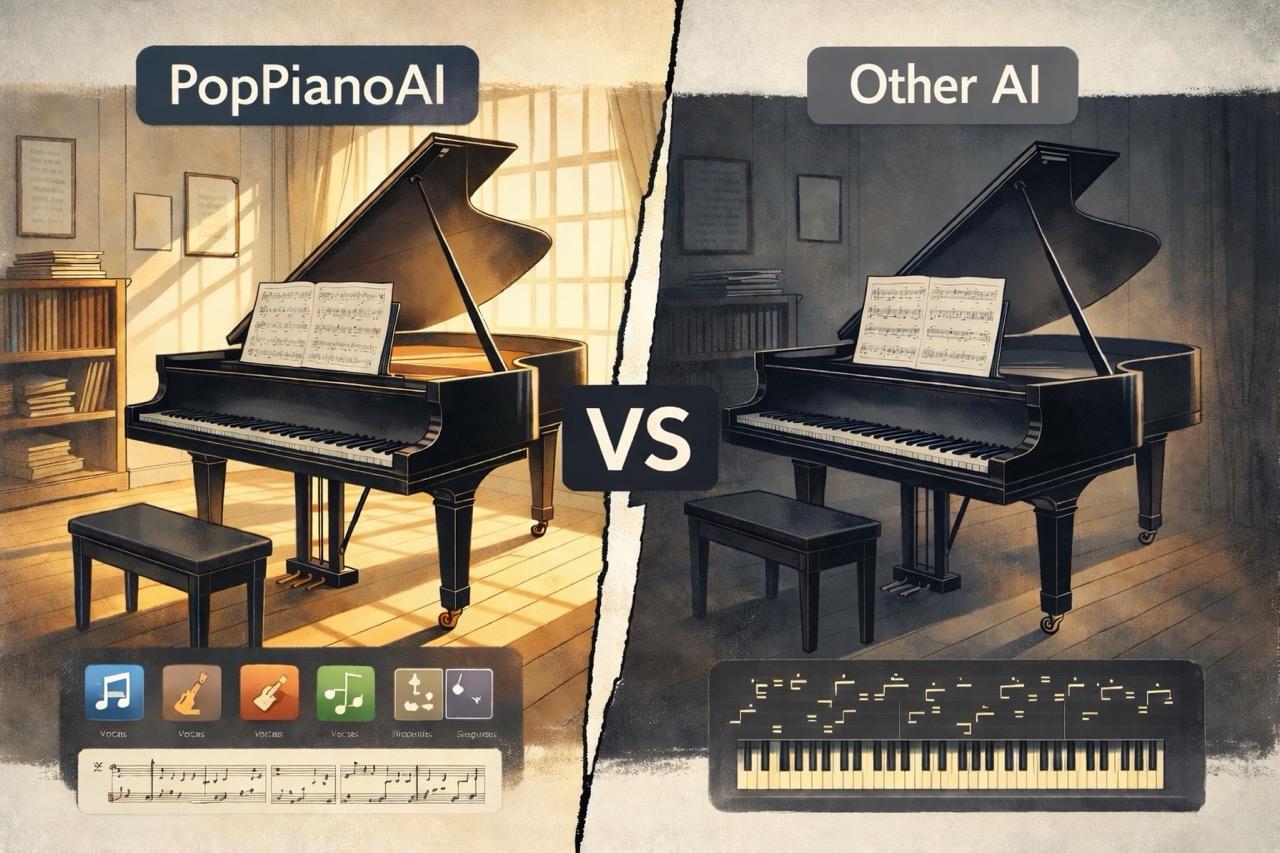
Why PopPianoAI Is Fundamentally Different from Other Piano Transcription AIs
The difference isn’t accuracy — it’s purpose
In recent years, many piano transcription AIs have appeared on the market. On the surface, they all promise the same thing: turning music into piano sheet music.
But after actually using them, many musicians quickly realize something important:
Not every AI-generated piano score is playable, musical, or useful in real situations.
The reason is simple. Most piano transcription AIs and PopPianoAI are designed to solve completely different problems from the very beginning.
The Core Difference: Transcribing Piano vs Creating a Piano Cover
Most piano transcription AIs focus on transcription.
Their job is to take an existing piano performance and convert it into sheet music.
The typical workflow looks like this:
Piano audio → note detection → rhythm analysis → full notation
These tools are excellent for:
- Recording piano performances
- Saving improvisations
- Converting MIDI files into sheet music
In short, they are designed to document piano music that already exists.
PopPianoAI works in a completely different way.
Instead of starting with a piano performance, PopPianoAI starts with the original pop song:
- Lead vocals
- Harmonies
- Guitar, synths, bass
- Drum grooves and rhythmic feel
It then re-arranges all of these elements into a piano cover, designed specifically for human hands and real performance.
In one sentence:
Traditional piano transcription AI:
Turns piano music into piano sheet music
PopPianoAI:
Turns a full pop song into a playable piano cover
Real-World Use Cases: Where the Difference Really Matters
Most piano transcription AIs have an important hidden requirement:
You must already have a piano version.
That means you need:
- A piano cover recording
- A MIDI piano file
- Or someone to play the piano first
Only then can the AI create sheet music.
In real life, this causes many problems:
- New songs are released with no piano covers yet
- Niche songs, worship music, or indie tracks often have no piano versions
- Even when a piano cover exists, it may not be playable or practical
The result is often the same:
No piano version → no sheet music → the song gets skipped.
PopPianoAI Starts Where Others Stop
PopPianoAI removes that limitation.
As long as you have the original song audio, PopPianoAI can directly create a piano score that:
- Works for solo performance
- Works for accompaniment or leading vocals
- Feels musical, not mechanical
This opens up many real-world scenarios:
- New releases that don’t yet have piano scores
- Live accompaniment, worship leading, or performance settings
- Musicians who want to play pop songs without arranging everything themselves
Two AIs, Two Completely Different Purposes
Traditional piano transcription AIs are best suited for:
- Converting existing piano performances into notation
- Educational analysis and documentation
- Post-arrangement cleanup
PopPianoAI, on the other hand, solves a different and often ignored problem:
What do you do when a song has no piano score at all?
It doesn’t just ask:
“What notes are being played?”
It asks:
“How should this song be played on piano so it actually sounds good?”
That includes musical decisions such as:
- Which parts to keep and which to simplify
- How to translate drum grooves into piano rhythm
- How to create clear contrast between verse and chorus
- Whether the result is playable by real pianists
Conclusion: PopPianoAI Solves the “No Sheet Music” Problem
Many songs are never played on piano—not because they aren’t beautiful,
but simply because there is no usable piano score.
PopPianoAI exists to solve that problem.
It’s not about writing down every note,
but about helping more songs be played, performed, and shared through piano.
Note: Users are responsible for ensuring they have the legal rights to use any audio files before creating piano cover scores. All outputs should comply with applicable copyright laws and usage permissions.